Rooting for Each Other: What the Smiling Vegetables Actually Ask
Four root vegetables sit in a row, smiling. A carrot, a radish, a beet and an onion, each with its roots visible in the soil beneath it. Around them, in a ring of capitals, runs the line: LET’S ROOT FOR EACH OTHER AND WATCH EACH OTHER GROW. The design is cheerful, almost childlike in its register, and it is doing something more interesting than it first appears.
The pun is the hinge. To root for someone is to support them, to will their success from the sidelines. To root, for a plant, is to establish oneself in the ground. The shirt holds both meanings at once, and the vegetables make the second literal: their roots are drawn, visible, doing the work that roots do. The first meaning is the one the sentence leads with. The second is the one the picture insists on.
That double meaning matters because the two kinds of rooting are not the same. Cheering someone on costs little and asks nothing of the person being cheered. Putting down roots is slower, more demanding, and involves staying in one place long enough for something to take hold. The shirt’s wording slides between the two, and the slide is where the useful question sits.
What the artwork shows, and what it doesn’t
The visual observation is straightforward: the phrase surrounds four smiling root vegetables — carrot, radish, beet and onion — with their roots visible in soil. The colours and exact lettering are a matter for the listing itself; what the design establishes is a circular arrangement, a garden setting, and a set of faces that are unmistakably friendly. The vegetables are not competing. They are not arranged in a hierarchy. They are simply there, together, in the same soil.
That is an interpretation of the composition, not a claim about the designer’s intent. But it is a reasonable reading of what the picture puts in front of a viewer: four different plants, each with its own root system, sharing a patch of ground. The phrase above them is an invitation, not an instruction. Let’s is doing quiet work — it proposes a joint action rather than demanding one.
If you are looking at the shirt itself, it is listed as the Let’s Root For Each Other And Watch Each Other Grow Garden design from Quirky Cotton Collective. The phrase is the kind of thing that gets printed on a shirt because it is warm and easy to like. The question worth asking is what it asks of the person who reads it.
Support is not the same as growth
The sentence has two halves, and they are not equivalent. Root for each other is the easy half. It is the language of encouragement, of the message sent before an interview, of the nod across a room. Watch each other grow is harder. Watching implies attention over time. Growth implies change, and change is not always comfortable to be near.
In community work, the distinction is familiar. It is easy to root for a group from a distance. It is much harder to stay close enough to watch it grow — to see the awkward stages, the false starts, the moment when a project that looked promising turns out to need more than anyone expected. The shirt’s phrase pairs the two, and in doing so it quietly raises the standard. Rooting is not enough on its own. The watching is where the real commitment sits.
There is a second tension in the word grow. Growth is not always the right goal. Some organisations need to consolidate, to shrink, to stop doing something that no longer serves. A phrase that celebrates growth can, if read too literally, become a demand for endless expansion — more members, more funding, more activity. The vegetables on the shirt are not growing into anything larger than themselves. They are simply rooted, and smiling, and present. That might be the more honest image.
The invitation and the boundary
What does let’s root for each other actually ask of another person? It asks for reciprocity. The phrase is symmetrical: each person roots for the other, and each is watched as they grow. It is not a one-way offer of support. It is a proposal for a mutual arrangement, and like any mutual arrangement it carries an implicit boundary. If I root for you, I am not promising to root for everything you do. I am promising to take an interest in your growth, which is a different and more specific thing.
That distinction is useful in practice. Community groups often struggle with the difference between supporting people and endorsing everything they propose. The shirt’s phrase, read carefully, keeps the two apart. Rooting for someone means wanting them to flourish. It does not mean agreeing with every decision they make. The watching is what allows the rooting to be honest: you can only genuinely root for someone’s growth if you are paying enough attention to see what is actually growing.
The smiling vegetables make this easier to hold. They are not earnest. They are a bit silly. The design does not demand that anyone take it too seriously, and that lightness is part of what makes the invitation bearable. A phrase that asked for mutual commitment in plain language would be heavy. A phrase that asks for it through a row of smiling root vegetables gives the reader room to accept it without feeling cornered.
What the shirt is, and what it isn’t
This is a piece of printed clothing. It is not a manifesto, a policy, or a programme. It does not cure anything, improve anything, or guarantee that the person wearing it will be any better at rooting for others than anyone else. What it does is put a small, legible argument into the world: that support and attention belong together, and that growth is something we watch in each other rather than something we demand.
That argument is worth taking seriously precisely because it is small. The shirt does not ask the reader to reorganise their life. It asks them to consider what it would mean to root for the people around them in a way that includes watching, and to accept being watched in return. In a sector that talks constantly about collaboration, that is a more specific and more demanding proposal than it first appears.
So what
For organisers: the next time you offer support to another group, ask whether you are rooting or watching. Both are useful, but they are not the same, and the second is the one that builds trust over time.
For funders: the phrase is a reminder that growth is not the only measure of success. A group that is rooted, stable, and present may be doing exactly what it needs to do. Watch for that, and fund it.
For policy officers: the invitation to root for each other is easy to endorse in a strategy document. The harder question is whether the structures you design allow for watching — for sustained attention to how things actually develop, rather than a single round of encouragement followed by silence.
The vegetables are smiling because they are in the same soil. That is the whole argument, and it is enough.
Editorial note: this publication and Quirky Cotton Collective share an owner.
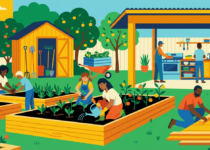
How Three Neighbors Turned a Vacant Lot Into the Heart of Elm Street

The Loudest Word in the Room: Reading the Large ‘meh.’ on a Dark Shirt
The Dashed Circle and the Solid Ball: What the ‘I Had Potential’ Shirt Actually Asks You to Read
About Author
