The 15-Minute City Backlash Is Real — Here’s What the Data Actually Says About Your Town’s Walkability Score
Why Everyone’s Arguing About Walking
Last year, you couldn’t scroll through local Facebook groups without hitting a wall of posts about the “15-minute city.” People were genuinely upset. Some saw it as a blueprint for livable communities. Others were convinced it was a plot to eliminate personal freedom. The conspiracy theories spread fast — researchers at First Draft tracked the conversation reaching roughly 52 million social media users. That’s a lot of heat for what started as a pretty straightforward urban planning concept.

The idea came from Paris Mayor Anne Hidalgo and urban planner Carlos Moreno. Basically: what if most of what you needed for daily life was within a 15-minute walk or bike ride? Groceries, healthcare, work, schools, parks. It’s not a new thought. But the way it got politicized in 2024 and 2025 turned a legitimate conversation about city design into something else entirely, which meant actual data got buried under noise.
So let’s dig into what’s really happening in American neighborhoods right now. Not the talking points. The actual numbers.
Most Americans Still Can’t Walk Anywhere
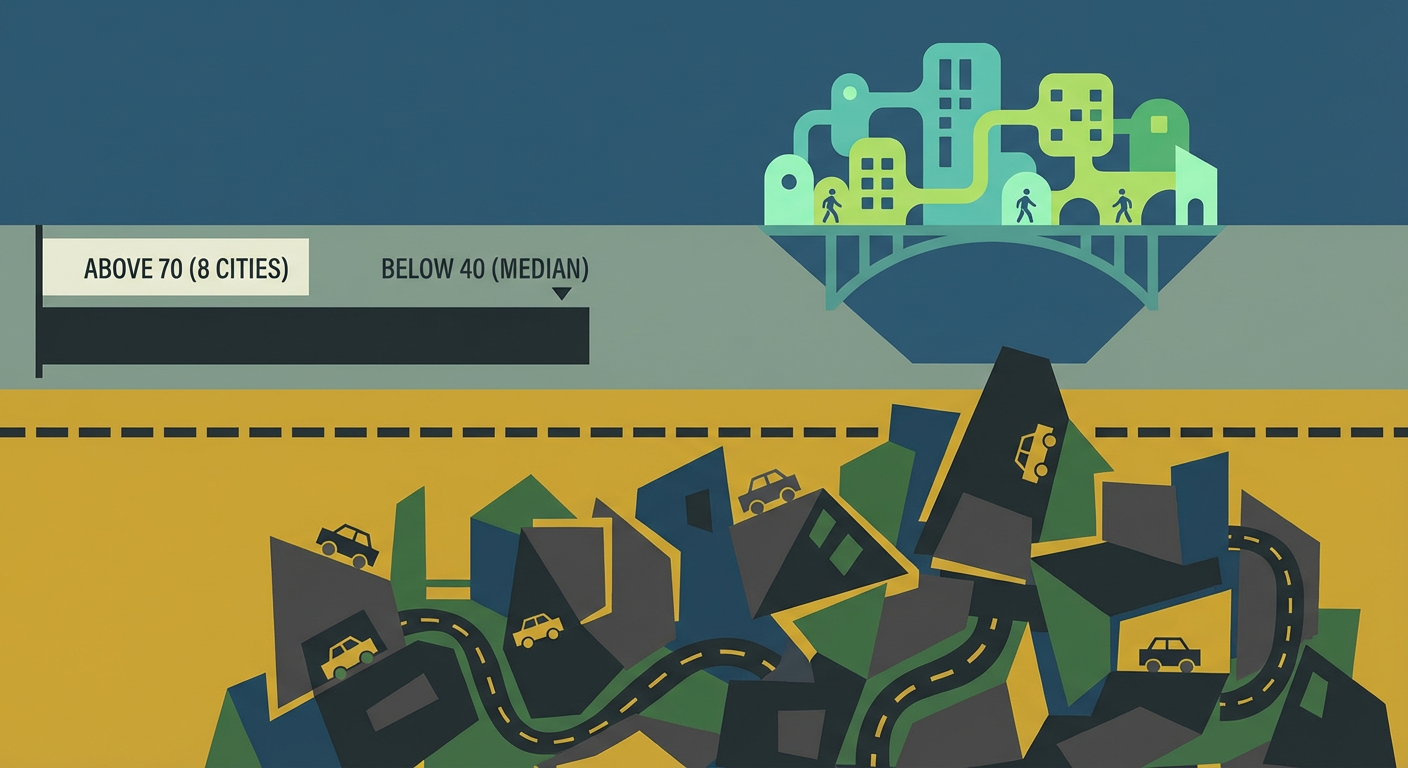
Here’s the baseline: Walk Score published their 2025 rankings, and the picture is stark. Only 8 U.S. cities scored above 70 on their walkability scale. Eight. The median American city scored below 40, which means most people need a car to buy milk, pick up prescriptions, or get to work. That’s not ideology. That’s infrastructure.
You can check where your own neighborhood lands with the Walk Score City Rankings. Punch in your address. It’ll tell you exactly how many errands require a vehicle in your specific area. The scoring system accounts for proximity to grocery stores, restaurants, shopping, coffee shops, banks, parks, schools, and libraries — measuring actual walkability, not wishful thinking.
People aren’t upset about having walkable neighborhoods. They’re upset about the framing, the speed of change, or feeling unheard in the process. But the underlying reality is that car dependency has structured itself into most American towns in ways that affect your health, your budget, and your actual freedom.
The Money Part (Which Nobody Wants to Talk About)
Let’s get practical. A household in a car-dependent area spends an average of $14,800 per year on transportation costs. That’s the figure from the Congress for the New Urbanism’s 2025 Sprawl Tax report. Meanwhile, households in walkable urban neighborhoods spend $6,200 annually on getting around. That’s $8,600 per year. For a lot of families, that’s real money.
You can read through the full analysis in the Congress for the New Urbanism Sprawl Tax Report. The report breaks down the direct costs of gas and car payments, plus parking, maintenance, and insurance. When you add it all up, car-dependent living is a financial structure that locks people in, whether they realize it or not.
This isn’t about judgment. It’s about options. If your neighborhood was designed in a way that makes walking impossible, you don’t have a choice. You pay the $14,800. And that shapes what else you can afford: childcare, housing, food quality, medical care. The system feeds itself.
What Walkability Actually Does to Your Body
A January 2025 study in The Lancet found something concrete: residents in walkable neighborhoods had 14 percent lower rates of cardiovascular disease than people in car-dependent areas, even after controlling for income. That’s a real health difference. Not motivational. Clinical.
Walking to run errands isn’t exercise in the gym sense. It’s incidental movement. You’re not thinking about cardio. You’re just living. And your body responds. The more research comes out, the clearer it gets: the places we’ve built have health consequences. Dense, mixed-use neighborhoods with decent transit aren’t just nicer to walk through. They’re measurably better for you.
Portland Did It, and Here’s What Changed
Portland, Oregon started their 20-Minute Neighborhood initiative back in 2012. They picked specific zones and worked with community groups to improve walkability, add transit connections, and create local gathering spaces. In 2024, they expanded the program. The Portland Bureau of Transportation released data showing a 9 percent reduction in vehicle miles traveled in target neighborhoods.
Nine percent doesn’t sound huge. But scaled across a city, it adds up. And here’s what actually happened: they didn’t ban cars or remove parking. They didn’t force anyone to change their life. They made walking more practical so people didn’t need to drive everywhere. Some people chose differently because the alternative actually worked.
That’s the model that gets traction without sparking backlash. It’s incremental. It involves the community from the start. It shows results before asking for more change. And it respects that people have jobs, kids, disabilities, and reasons that walking might not be the answer for them personally. The goal isn’t purity. It’s options.
What You Can Actually Do About This
Start with the numbers for your own neighborhood. Check your Walk Score. Look at your actual transportation budget. Then attend one city council meeting about land use or transportation planning. Read the minutes if the meeting sounds boring. You’ll find the actual decisions that shape whether walking is possible in your area.
Talk to your neighbors about it. Not the conspiracy stuff. The real question: do you want more choices for how to get around? That’s not political. That’s practical. When local governments see that residents care about this, they shift priorities. The 15-minute city concept got polarized partly because it felt like something being done to communities rather than with them. You can change that in your own area.
Share what you find. If your neighborhood is car-dependent and expensive, say so. If you’ve noticed places where walking got better, point them out. This is how change actually happens. Not through national debates. Through local people looking at their own blocks and deciding what they want next.

The Quiet Strength of Voluntary Organizations in Crisis Response
How to Run Effective Community Consultations: A Practical Guide for Meaningful Engagement

Robo Revolution: The Golden Era of Robotics
About Author
