The Tuesday Morning Revolution: How Three Neighbors Are Rewriting the Small Business Playbook
Maria’s Map and the Missing Pieces
Maria Gonzalez spreads a hand-drawn map across the counter of her corner market every Tuesday morning at 8:15 AM. It’s not a treasure map, though it might as well be. Each X marks a small business within six blocks of her store, and each red circle shows where a business closed in the past two years. The red circles are winning.
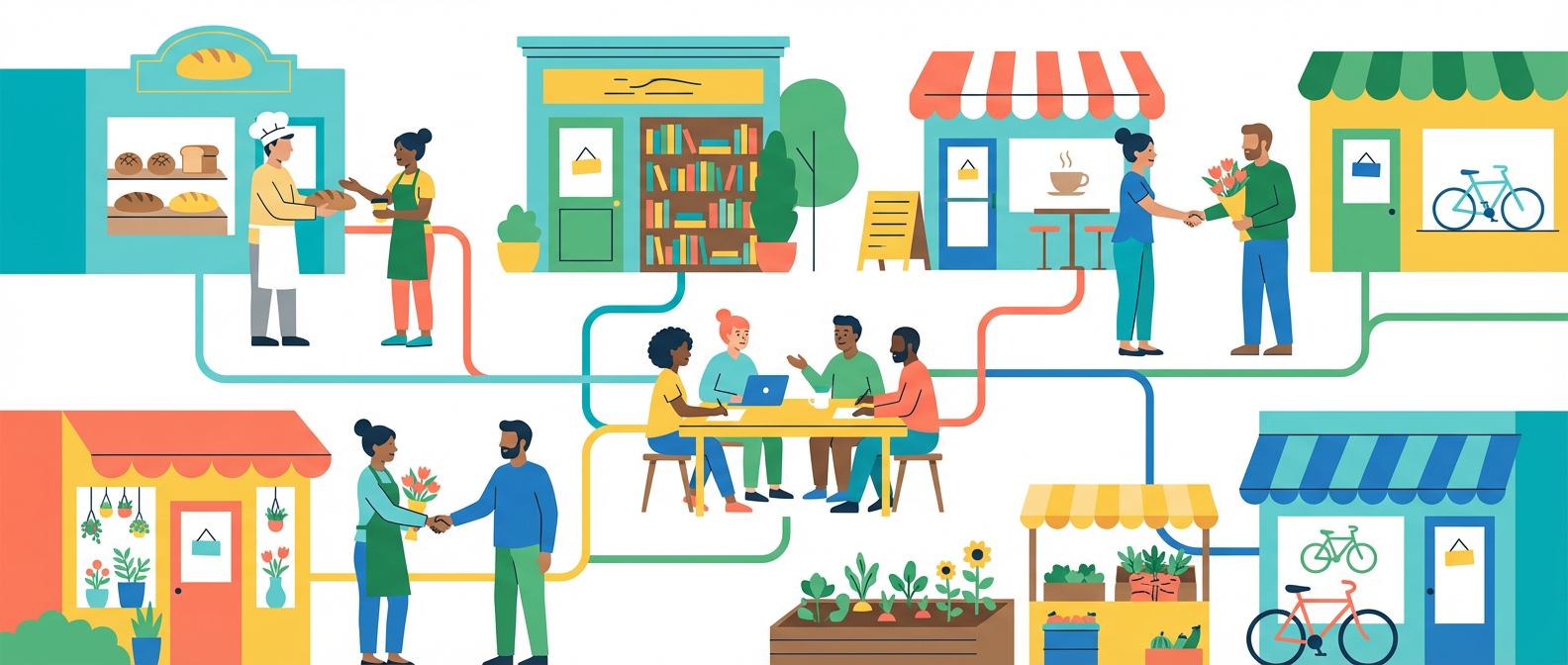
“See this?” She taps the paper where Riverside Avenue meets Third Street. “That was Chen’s Electronics. Forty-two years in business. His son wanted to keep it going, but the rent doubled and the foot traffic just wasn’t there anymore.” Her finger moves to another spot. “And here was Delilah’s Hair Studio. She’s doing cuts in her basement now because she couldn’t make the numbers work.”
Maria isn’t just documenting decline. She’s building a case for something different. Her map shows the invisible network that keeps neighborhoods alive. And she’s figured out that the solution isn’t waiting for someone else to fix things. It’s Tuesday morning coffee with two other business owners who refuse to watch their community hollow out.

The Accidental Alliance
David Kim from Northside Books didn’t plan to become a revolutionary. He was just tired of watching customers browse his shelves, scan ISBN codes on their phones, and walk out empty-handed to order online. “I started thinking about it wrong,” he explains, adjusting his glasses as he talks. “I kept trying to compete with Amazon on Amazon’s terms. That’s like challenging a freight train to a race while you’re on a bicycle.”
The breakthrough came during a particularly brutal January when his heating bill exceeded his revenue. Instead of panicking, he called Maria. Then he called Janet from the coffee roastery two blocks over. “What if we stopped thinking like separate businesses and started thinking like a neighborhood ecosystem?”
Janet Martinez had been asking herself the same question. Her coffee roastery was packed in the mornings but dead by 2 PM. Her lease included 800 square feet she barely used. “I had this space just sitting there while David was worried about rent. Meanwhile, Maria was telling me how her customers kept asking where they could get fresh coffee beans. None of us had the full picture until we put our maps together.”
Their first collaboration was almost embarrassingly simple. David moved his used book section into Janet’s afternoon dead zone. Customers could browse books while Janet pulled shots and roasted beans in the background. Maria started stocking Janet’s coffee beans and David’s book recommendations. The real magic happened in the conversations that followed.
Making the Invisible Visible
Walk down Riverside Avenue on any given Wednesday and you’ll see something that looks ordinary but is actually radical. A customer buys a bag of Janet’s medium roast from Maria’s market, mentions they’re looking for a birthday gift, and Maria hands them David’s business card along with a note about the rare book collection upstairs. David recommends customers grab lunch from Maria’s deli counter before settling in to read. Janet’s afternoon crowd now includes people who started their morning at Maria’s and spent their lunch break browsing David’s shelves.
The numbers tell the story better than any business school case study. David’s revenue increased 28% in six months, not from selling more books online but from selling different books to people who were already in the neighborhood. Janet expanded her afternoon hours and hired her first part-time employee. Maria’s coffee bean sales tripled, and she started carrying locally made products from eight other small producers.
The real victory is in what you can’t easily measure. “Mrs. Patterson used to drive fifteen minutes to the big chain grocery store,” Maria explains. “Now she walks three blocks to my place, gets her coffee from Janet, and picks up a mystery novel from David. She’s spending the same money, but it’s staying in the neighborhood. And she’s not isolated in her car. She’s talking to people.”
The Ripple Effect Nobody Expected
By September, something unexpected was happening. Other business owners started asking questions. The owner of the struggling toy store wanted to know if she could sell Janet’s coffee during the holiday shopping season. The couple who runs the small engine repair shop asked if they could recommend David’s books to customers waiting for service. Even Chen’s son reached out about possibly reopening his father’s electronics business in partnership with the existing businesses.
The city council took notice too. Councilwoman Rebecca Torres showed up at Janet’s on a Tuesday morning, not for a photo opportunity but for a real conversation about zoning rules that make collaboration difficult. “They’ve proven something we’ve been talking about in abstract terms for years,” she says. “Small businesses can compete with big chains, but not by becoming smaller versions of big chains. They compete by becoming something big chains can never be: part of the community fabric.”
Maria’s map now shows green circles alongside the red ones. Green for new collaborations, green for businesses that found their footing by working together, green for empty storefronts that might have possibilities instead of just problems. The map is getting crowded in the best possible way.
Your Turn to Draw the Map
What’s happening on Riverside Avenue isn’t complicated or expensive. It doesn’t require grants or government programs or consultants with PowerPoint presentations. It requires three things that every neighborhood already has: business owners who care about their community, customers who want to be more than transactions, and the willingness to have conversations that go beyond small talk.
Start with your own map. Draw a six-block radius around where you live. Mark the small businesses that are thriving, the ones that are struggling, and the empty spaces where businesses used to be. Then walk to the nearest small business and ask the owner what they’re seeing and what they need. Not to solve their problems, but to understand the ecosystem you’re already part of.
Maria’s Tuesday morning coffee meetings are open to anyone who wants to understand how neighborhoods really work. She’ll show you her map, explain the connections that keep communities alive, and probably convince you that small changes can create big differences. Just don’t be surprised if you leave planning to plant trees on Saturday or find yourself reading city council minutes over your morning coffee. Some revolutions start exactly that quietly.

The Tuesday Morning Coffee Revolution: How Three Neighbors Changed Everything

Why Local Knowledge Should Lead Policy Design
When the Floor Falls Through: Voluntary Organisations in Crisis Response
About Author
